Last checked against official pages: 18 November 2026.
Quick answer
Namba is compact, crowded and easy to walk once you know a few corners. Start at Hozenji Temple, where the cobbles stay wet because people ladle water over the moss-covered Fudo statue. Eat nearby: okonomiyaki at Okaru, takoyaki at Wanaka next to Namba Grand Kagetsu, and kushikatsu at Daruma (no double-dipping). The Glico sign on Dotonbori is a quick photo, not a long stop. For comedy, use the front entrance of Namba Grand Kagetsu; the younger-comedian house, Yoshimoto Manzai Theater, is across the way. For Universal Studios Japan, take the Hanshin Namba Line to Nishikujo, then the JR Yumesaki Line to Universal City — not a taxi as your first plan, and not the Kintetsu line, even though Osaka-Namba is a shared station.
This article began with a 23-minute comedy sketch, not a guidebook. In 中川家の寄席2026 「なんばの無料観光案内所」 (uploaded 13 November 2026), the manzai duo Nakagawake play a free tourist office in Namba, talking over a big paper map. It is a yose routine, full of timing and exaggeration. The geography, though, is broadly right: the wet stone alley, the smell of tonkotsu at a Metro exit, the difference between Dotonbori's front and the quieter streets to the west.
We have not copied the routine. Hours, access and official names below were checked against the venues' own pages and the Osaka tourism bureau on 18 November 2026. Where a number or opening time could not be confirmed, we left it out. Comedy bits that are just jokes — hanging around a stage door, punchlines about crime, or "don't bother going there" as a running gag — are not advice.
Credit: 中川家の寄席2026 「なんばの無料観光案内所」 by 中川家チャンネル (YouTube).
A real tourist office, not a comedy set
The "free tourist information centre" in the sketch is a studio desk. There is a real, free one a short walk away.
Namba Tourist Information Center (難波観光案内所), run with the official Osaka tourism bureau, sits in front of the north exit on the first floor of Nankai Namba Station. As of the official Osaka-info page, it is open 9:00–20:00 daily, with staff who can help in English, Chinese and Korean. There are also official desks at JR Osaka Station and JR Shin-Osaka. If you need a map, a train plan or a straight answer, start here.
Open in Google Maps: Namba Tourist Information Center
Hozenji: smaller than the pamphlet, and always a bit wet
The most useful idea in the sketch is to treat Namba as a walk, not a checklist of famous signs. A few minutes off the main streets, Hozenji (法善寺) sits in a stone alley, Hozenji Yokocho. The official temple site is houzenji.jp. The grounds, including the Mizukake Fudo (水掛不動尊), are open to visit 24 hours; the office that sells charms and temple stamps is listed as 10:00–18:00. The address is 1-2-16 Namba, Chuo-ku.
People ladle water over the Fudo, which has turned thick with moss, and the cobbles stay damp. That is why the alley always looks slightly wet, even when it is not raining. The statue is also smaller in person than it looks in tourist photos — still worth the two-minute detour. Be careful on the stones, and do not block the people who are actually there to pray. For more temples around the city, see our guide to historical temples and shrines in Osaka.
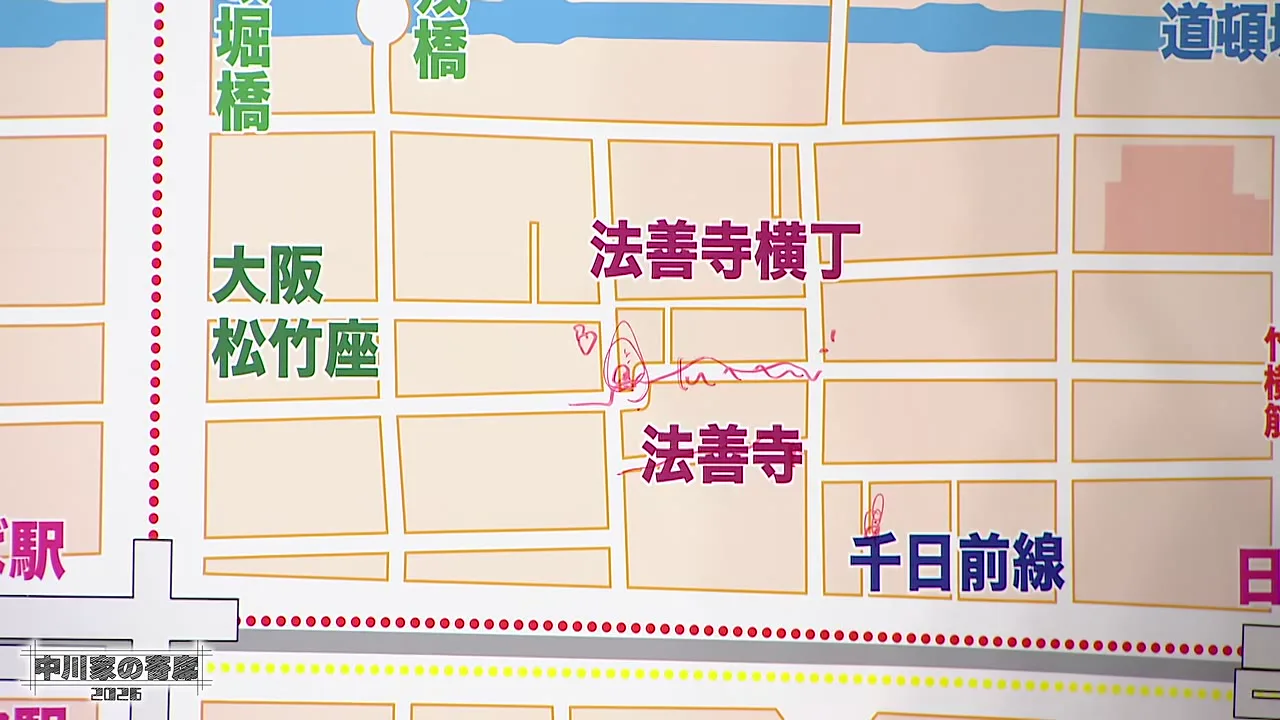
Screenshot from "中川家の寄席2026 「なんばの無料観光案内所」" by 中川家チャンネル (YouTube)
Open in Google Maps: Hozenji Temple (Mizukake Fudo)
What to eat while you are here
Osaka's usual three — okonomiyaki, takoyaki and kushikatsu — really are all close together in this part of Namba. Plenty of shops are good. The sketch names a few specific ones; we kept the ones we could confirm.
Okaru, for okonomiyaki
Okaru (お好み焼き おかる) is a small, old-style shop near Hozenji, at 1-9-19 Sennichimae, Chuo-ku. The shop's own site lists hours as 12:00–15:00 (last order 14:30) and 17:00–22:00 (last order 21:30), closed on Thursdays and the third Wednesday of the month. It also says cards are not accepted. A well-known quirk, reported for years in travel write-ups, is that staff will draw on the finished okonomiyaki with mayonnaise, sometimes a portrait if you ask. It is a small room and often has a line; if you dislike mayonnaise, this is not your shop.
Open in Google Maps: Okonomiyaki Okaru
Wanaka, next to Namba Grand Kagetsu
If you want takoyaki on this walk, Takoyaki Doraku Wanaka Sennichimae Honten (たこ焼道楽 わなか 千日前本店) is the stall the sketch treats as the one on the corner by Namba Grand Kagetsu. The official shop list puts it at 11-19 Nanba-Sennichimae, Chuo-ku, open 10:00–23:00 on weekdays and 8:30–23:00 on weekends and public holidays. Wanaka also has other Osaka shops, including one at Shin-Osaka Station's Arde mall — the routine is right that you can find the name there too, but the Namba walk starts at the Sennichimae honten. For a wider food crawl, see our Osaka street food guide.
Open in Google Maps: Takoyaki Doraku Wanaka Sennichimae Honten
Kushikatsu Daruma: start in Namba, or go to Shinsekai
Kushikatsu Daruma (串かつ だるま) is the chain behind the "no double-dipping" rule that every Osaka visitor hears about. The sauce pot is shared, so you dip once. In Namba, the official Namba Honten is at 1-5-24 Namba, Chuo-ku, in the Daruma Building. The official page lists 11:30–22:30 on weekdays and 10:30–22:30 at weekends and holidays, last order 30 minutes before closing, open every day. One drink per person is required, except for children in elementary school or younger.
The original neighbourhood, though, is Shinsekai, at the foot of Tsutenkaku. The official site still lists a Shinsekai Sohonten and a Tsutenkaku shop there. If you want that older street atmosphere, it is a subway hop, not a pleasant long walk with fried food already in your stomach. There is also a Daruma Building in Kitashinchi, north in the Umeda area — take the Midosuji Line rather than walking from Namba. More kushikatsu options are in our Dotonbori kushikatsu guide, and Shinsekai has its own neighbourhood guide.
Open in Google Maps: Kushikatsu Daruma Namba Honten
Open in Google Maps: Kushikatsu Daruma Tsutenkaku
Open in Google Maps: Kushikatsu Daruma Kitashinchi (Daruma Building)
Kinryu Ramen and Metro Exit 14
A classic Namba arrival is Osaka Metro Namba's Exit 14, which the official station exit list gives as the way out toward Dotonbori, Shinsaibashi-suji and Hozenji. Come up the stairs and the first thing many people notice is the smell of tonkotsu broth. Kinryu Ramen (金龍ラーメン) has several shops in Minami, including the Dotonbori shop a short walk from that exit, often recognised by a large dragon figure. The company's own site, kinryuramen.com, lists the Dotonbori, Midosuji, Ebisubashi, Namba-Sennichimae and Aiai-bashi (honten) shops. Hours are not clearly listed there, and at least one branch has been marked as temporarily closed for renewal, so check the shop in front of you rather than assuming a 24-hour service. For more bowls around the city, see our Osaka ramen guide.
Open in Google Maps: Kinryu Ramen Dotonbori
The Glico sign, Dotonbori and Soemoncho
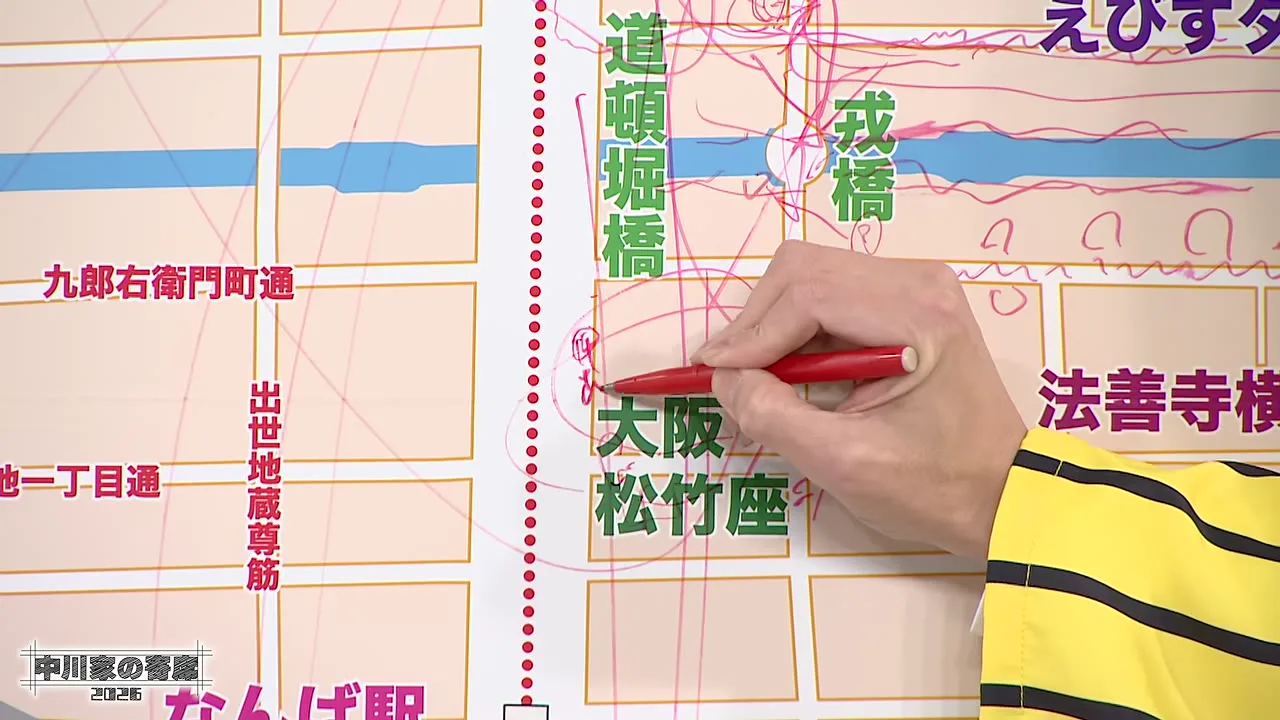
Screenshot from "中川家の寄席2026 「なんばの無料観光案内所」" by 中川家チャンネル (YouTube)
The Glico running-man sign on Dotonbori is the photo everyone is told to take, usually from Ebisubashi (戎橋). It is worth doing once. It is not a long visit: you walk onto the bridge, take the picture, and the crowd moves you on. Dotonbori itself is a short canal-side strip of signs, seafood restaurants and, these days, a lot of drugstores aimed at visitors.
Open in Google Maps: Glico sign / Ebisubashi (Dotonbori)
Just north of the canal is Soemoncho-dori (宗右衛門町通り). In the daytime it is a narrow one-way street with restaurants and hotels. At night it is a nightlife street: host clubs, flashy cars turning in from Midosuji, and not much room to walk. If you only want a stroll, go in daylight and keep to the side. The sketch's running joke about hosts warming themselves on restaurant steam is a night-time picture, not a lunch plan.
Tsurutontan Soemoncho (つるとんたん 宗右衛門町店) is the large-bowl udon shop the routine points out here. The official page lists it at 3-17 Soemoncho, Chuo-ku, open 11:00–6:00 the next morning on weekdays and Sundays, and 11:00–8:00 the next morning on Fridays and Saturdays. This is the 1989 shop that set the format; there are branches in Tokyo and elsewhere now.
Open in Google Maps: Soemoncho-dori
Open in Google Maps: Tsurutontan Soemoncho
Kani Doraku (かに道楽) is the crab restaurant with the moving crab signs. The company's official shop list names three on this stretch: Dotonbori Honten (1-6-18 Dotonbori), Dotonbori Naka (1-6-2) and Dotonbori Higashi (1-1-3). You do not have to eat there to understand the street; the signs are the landmark.
Open in Google Maps: Kani Doraku Dotonbori Honten
Osaka Shochikuza (大阪松竹座) sits on this same side of Dotonbori, a proper theatre for kabuki and stage shows rather than a comedy house. The area around the doors is busy before and after performances. We have a separate guide to the Shochikuza.
Open in Google Maps: Osaka Shochikuza
Comedy theatres: Namba Grand Kagetsu and Yoshimoto Manzai Theater
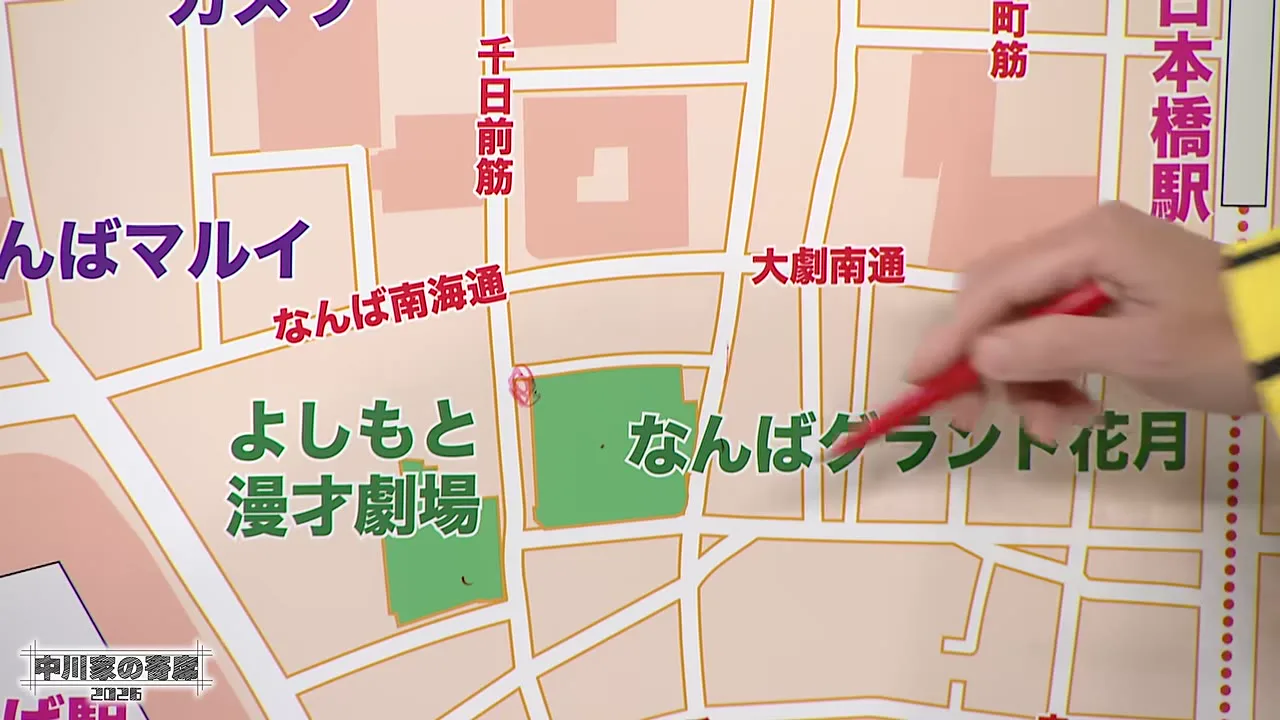
Screenshot from "中川家の寄席2026 「なんばの無料観光案内所」" by 中川家チャンネル (YouTube)
Namba Grand Kagetsu (なんばグランド花月, often just NGK) is Yoshimoto's main Osaka theatre — manzai, rakugo, comedy sketches and Yoshimoto Shin-Kigeki. The official access page lists 11-6 Nanba-Sennichimae, Chuo-ku, and 858 seats. Come via the front: from Osaka Metro Namba Exit 3, through NAMBA Nannan exit E5, into Nankai-dori and right at the first crossing. Tickets are sold through the theatre's official site and FANY Ticket; check there for the day's programme rather than arriving on spec.
The back street is a stage door, not a second attraction. Performers use it as a workplace entrance. Watch a show if you want to see them; do not wait outside the door.
Open in Google Maps: Namba Grand Kagetsu
Facing it, in the YES NAMBA building, is Yoshimoto Manzai Theater (よしもと漫才劇場), the house for younger acts. The official page puts it at 12-7 Nanba-Sennichimae, Chuo-ku, 5F, with 305 seats, a short walk from NGK. Programmes and prices change by bill; buy through the official site or FANY.
Open in Google Maps: Yoshimoto Manzai Theater
If you have more time: Doguyasuji, Kuromon and Amerikamura
Sennichimae Doguyasuji (千日前道具屋筋商店街), just by the two theatres, is Osaka's kitchen-goods street — knives, plastic food samples, aprons, restaurant supplies, in the same spirit as Tokyo's Kappabashi. It is one of the more practical "souvenir" walks in Namba if you actually cook.
Open in Google Maps: Sennichimae Doguyasuji shopping street
A little further east is Kuromon Market (黒門市場). It is a covered food market, and it is often extremely crowded with visitors. Shop opening times vary by stall; use the market's own information rather than a single set of hours. Go early if you want room to walk.
Open in Google Maps: Kuromon Market
West of Midosuji, Amerikamura is the youth-fashion grid around Sankaku Park (三角公園; officially Mitsu Park, 御津公園). It is sometimes sold as "Osaka's Shibuya." That is too much weight for a triangular park, a police box and a few lively streets. It is still a good short walk for shops and people-watching. Europe-dori (ヨーロッパ通り) is a useful edge: one side stays relatively calm, the other is busier nightlife. South and west of here, Horie (especially Minami-Horie) is the cafe and fashion side, a former wholesale district rather than a tourist strip.
Open in Google Maps: Sankaku Park (Amerikamura)
Open in Google Maps: Europe-dori (Amerikamura)
Open in Google Maps: Minami-Horie
South of Dotonbori, locals still say Ura-Namba for the dense drinking streets. Some places spill onto the pavement; it can be cheaper and less polished than the canal. It is a night-time neighbourhood, not a sightseeing course, and quality varies shop by shop.
Open in Google Maps: Ura-Namba
The sketch is harsh about JR Namba and Minatomachi River Place — "nothing there but apartments." That is comedy. The area is simply quieter: OCAT, highway access, hotels and a riverside complex, useful if you are arriving by JR or highway bus, not the centre of a first-time walk. If Namba already feels like enough, you can skip it without missing the main sights.
Open in Google Maps: Minatomachi River Place / JR Namba
Namba is only one slice of Minami. For hidden corners, see our hidden gems in Namba and the Shinsaibashi shopping guide. East of Kuromon, Nipponbashi is its own world of electronics and hobby shops: Den Den Town.
Getting to USJ from Namba
The sketch's one clear transport tip is right in spirit and slightly wrong in the name of the line. From Osaka-Namba, you do not take Kintetsu to Nishikujo. You take the Hanshin Namba Line to Nishikujo (西九条) — Hanshin's own station page lists it — then change to the JR Yumesaki Line (Sakurajima Line) for Universal City, which sits next to the park. Osaka-Namba is a shared station complex, which is why the names get blurred in conversation.
A taxi can do the same trip, but the train is usually simpler. Confirm the day's details on the official USJ train access page before you go, and see our theme parks guide if you are planning the visit itself. For getting around underground in the city, use our Osaka Metro guide.
Open in Google Maps: Universal Studios Japan
Sources
- Nakagawake, 中川家の寄席2026 「なんばの無料観光案内所」, 中川家チャンネル, uploaded 13 November 2026.
- Namba Tourist Information Center, Osaka Convention & Tourism Bureau (Osaka-info).
- Hozenji official site.
- Okaru shop information.
- Takoyaki Doraku Wanaka official shop list.
- Kushikatsu Daruma official locations, including Namba Honten and Tsutenkaku.
- Kinryu Ramen shop list.
- Tsurutontan Soemoncho.
- Kani Doraku official shop list.
- Namba Grand Kagetsu, theatre information.
- Yoshimoto Manzai Theater, theatre information.
- Hanshin Electric Railway, Nishikujo Station.
- Universal Studios Japan, train access.
Hours and programmes change. If a time matters to your day, recheck the official page on the morning you go.